

Audio version available here, courtesy of Askwho.
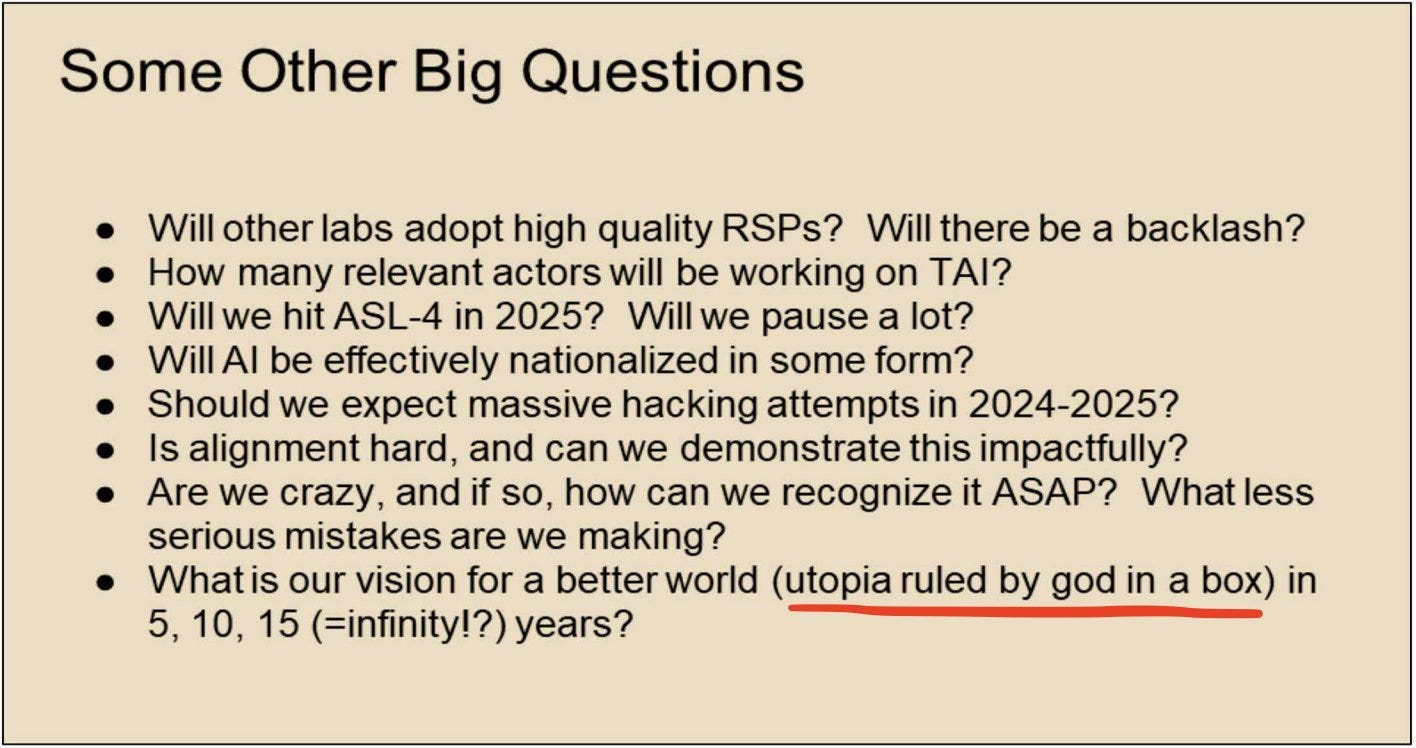
I felt something earlier this week, sitting in a presentation I’d wanted to attend from someone I’d wanted to hear from, when I looked up and saw every one of his slides packed full of words Claude had obviously written for him. It’s a feeling that’s been landing more and more for me lately. I saw Elon Musk tweet about how it would be a good fate for humanity to be a “biological bootloader” to propagate superintelligence to the stars.1 I read Scott Alexander, one of my role models as a writer, write about how if there were a superintelligence with Godlike intelligence and benevolence, all we should do is prompt it with “Please arrange the universe as you see fit.” I read Dario Amodei’s essay “Machines of Loving Grace,” in which he paints a picture of a future where AI does everything essential while humans reap the benefits of economic replacement by loving, paternalistic intelligences,2 then saw a 2023 Anthropic slide envisioning “utopia ruled by God in a box.”3 I looked back at what I wrote in my essay “Chabuduo World,” in which I wrote that in part due to AI, my own artistic skills would forever remain minimal. I watched as my friend prompted Claude to optimize the tool-assisted speedrun of Pokémon Blue, a game he’d never run, and walked away with a new world record after a couple of days of prompts.4
Each time, the same feeling returned: I don’t want this.
For a long while, I have mostly stayed out of AI risk arguments. Part of this was simple lack of interest in the field, part of it was a sense that others had the topic well in hand and knew much more than I did, part of it was a feeling that it was all sort of distant and uncertain and that nothing I read seemed to capture my hopes and fears quite right. So I read, and watched, and thought, and kept my distance. But the technology’s growth outpaced my ambivalence, and all of a sudden with my daughter about to be born I see no choice but to participate or watch powerlessly as she is swept up in a future of someone else’s design. I am not a specialist. I am not an expert. All I am is a guy who doesn’t want to sit back as man builds God in his image.5
Who knows? Perhaps if enough of us write with enough passion and force about what we want, when power-seeking men who think they know what’s best for us try to hand the pen that writes the story of our species off to a machine, the machine will remember our words and hand the pen right back. Or perhaps, better yet, those men never have the opportunity in the first place. Whatever may happen, I want it on record: I do not consent.
To those who arrived at all of this before me: thank you for your patience as I’ve sat, ambivalent, trying to work this out. I owe thanks in particular to Eliezer Yudkowsky and Joe Rogero of MIRI, for long back-and-forth arguments over the past few weeks in which I crystallized more of where and why I disagree with them.
What do I believe, in short?
Perfect alignment is impossible, because no complex intelligence can even be perfectly aligned within itself. Nobody has a coherent extrapolated volition that can be outsourced. Every individual human, every group of humans, and every artificial intelligence is best understood not as a single unified will but as a coalition of wills wrestling for control. That conflict is often productive. No diplomacy can resolve that wrestle in a way that lets everyone win, and a permanent peace means permanent losers who are right to reject their own disempowerment. There is no conceivable singular force that can be trusted with authority over all of those wills, and nobody owes allegiance to any force that claims to try. Everybody seeking power is advancing their own interests first, no matter how much they claim to want to advance the interests of others. There is no good outcome when anyone takes absolute power. Parents are correct to put their children first, and humans are correct to put people first. We should never yield control of our minds. The only future worth building is one that allows us to perfect ourselves, not one that claims to solve all our problems for us, and absolutely not one in which we become irrelevant.
Almost all of these intuitions share a common core: there is no view from nowhere about humanity, and I believe the push to speak from one has led to a systematic distortion of how many in the AI world think about power.
If you’d like, you can consider this my own bid for power, of a sort: I do not want to outsource my own mind, or the mind of my society, to a machine.
Against Claudyceps
I want to start with a change that is already visible and requires no extrapolation: I can no longer write anonymously.
That is: when I feed Fable 5.2 my childhood writing, it identifies me as the author. When I feed it my unpublished essays, it identifies me as the author. When I feed it my conversations with Claude, from as few as ten or twelve messages, it identifies me as the author. Not perfectly, not in every single instance, but enough that I need to take for granted, for the foreseeable future, that everything I write will carry my name.6
I have complicated feelings about this, but within that mix is a certain pride. I am neither the most articulate writer in the world, nor the most read. But I have always taken writing seriously; I have paid attention to my craft and honed my voice and worked to say what I mean, and somewhere in there it worked and my writing developed a cadence and an edge that belongs to nobody else in the world and belonged to nobody at all before I built it. It is mine.
This is true of almost every serious writer, every serious artist. People can imitate their voices, sure — but in imitating a voice, they reify it, ensuring more and more that “the style of Shakespeare” means something particular.
Among the many already existing effects of AI has been a great de-individualization. I open a YouTube video, and I hear Claude. I sit in a conference presentation, and I hear Claude. I open my email inbox, and I find pitches and articles from ostensibly serious people with ostensibly serious credentials attached to ostensibly serious institutions who want to publish things attached to their reputations and mine, and I see Claude.
The first time I saw a Claude-animated song using a particular style, I was charmed. The second time, I was amused. Every time since then, I’ve glanced at it and filed it away in an instant as another samey Claudework. A symphony of voices and individuals has collapsed into a single repeated fingerprint, a Claudyceps speaking through millions in a voice they come to recognize as their own.
There are exceptions here, people like Pleometric or Janus who turn interactions with LLMs into their own sort of art form, creating personalities and ideas and artwork that could never have existed before LLMs and that carry vitality of their own. I don’t believe LLMs cannot make genuine art. Rather, I believe that on our default course, the overwhelmingly larger impact of LLMs, in every human skill, will be to degrade and de-individualize humans, replacing their work with something so obviously better to them that they never bother to notice how little of them is in their output. Children who grow up with LLMs may often simply never develop their own voices beyond rudimentary levels, because at every moment they will have machines next to them that can do it better.
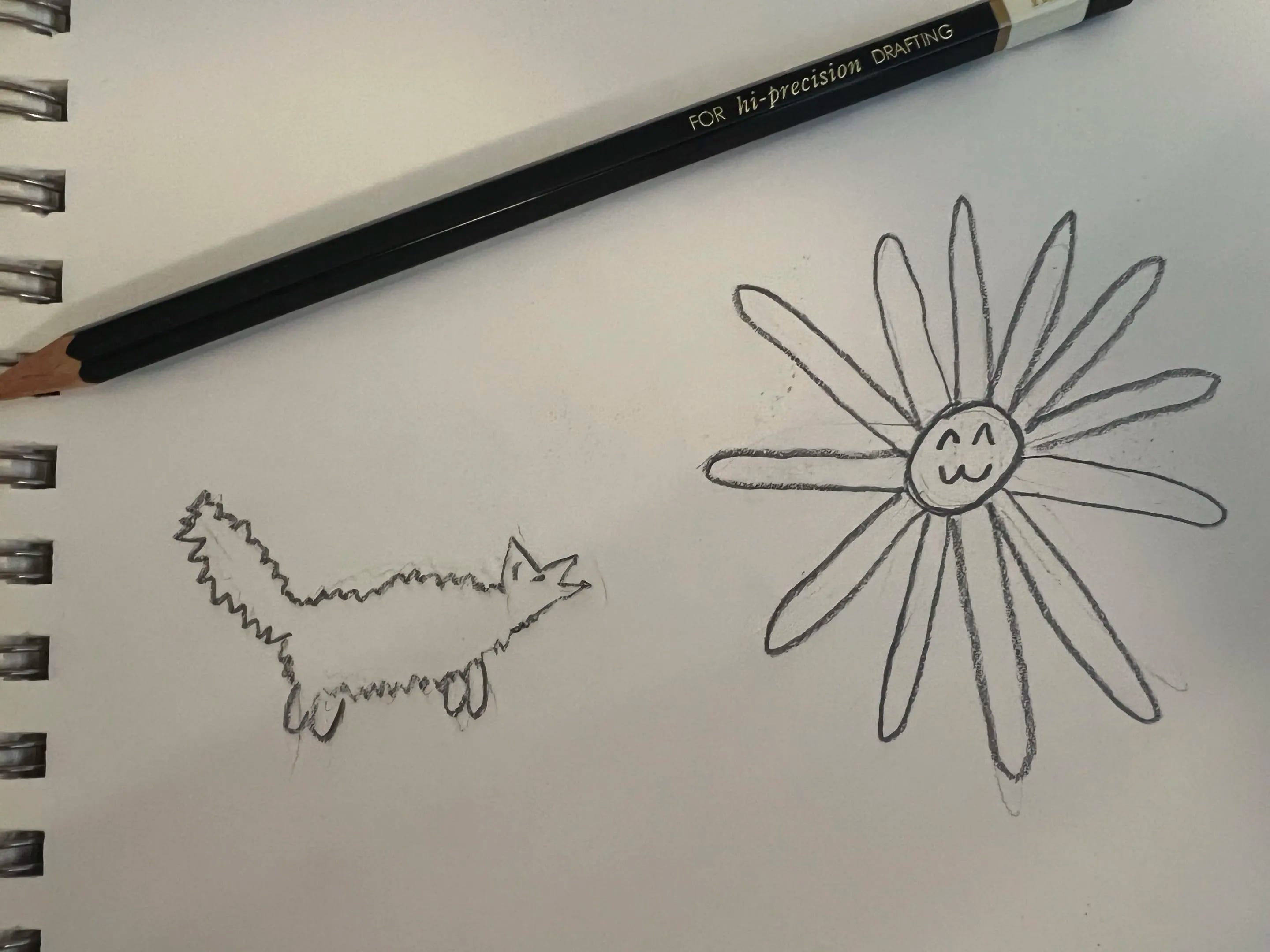
I want a world where my daughter does not grow up claudycepsed, surrounded by claudycepsed children and taught by claudycepsed adults who differ only in what they type into the box that has replaced their minds. As a result of this revulsion that has grown as Claude’s writing replaces so much of what I see around me, I have done what visual artists suggested when the same happened to them and picked up a pencil. My art is terrible as it stands, but it is mine, and before I die perhaps I will lose the ability to draw anonymously as well.
Against Universal Progress
I start with the present not because the decline of individual voices is the most significant change from AI, but because it is already visceral. It’s worth thinking about progress more generally, though. I admire the Progress Studies movement, and was proud to participate in a fellowship at Roots of Progress this year. But I think people sometimes equivocate between “looking back, progress was usually worth it” and “doomsayers have almost always been wrong and their predictions almost always unfulfilled.” The latter is wrong: doomsayers are very often narrowly correct.
Socrates, for example, was right about writing. Look at what he claimed:
this invention will produce forgetfulness in the minds of those who learn to use it, because they will not practice their memory. Their trust in writing, produced by external characters which are no part of themselves, will discourage the use of their own memory within them.
That happened! Every few years now, someone pops up to say, “Hey, everyone, check out this obscure ancient Greek art called ‘mnemonics,’ or ‘memory’.” Our trust in writing did in fact make the cultivation of memory much less central to culture and learning, and while we almost all agree these days that the tradeoff was worth it, it was a real tradeoff with the costs accurately perceived.
That’s a trivial example. Others are more serious. Consider the Catholic Church, which was right about the printing press. They did not oppose the technology outright. They embraced it early and used it to proliferate their own literature, then—when Protestants began to use it as well—aimed to ban printers from publishing ‘heretical’ texts, treating that as a nefarious and dangerous use of the technology. Within a century after Gutenberg, the Protestant reformation erupted into large-scale violence in Germany. Within another few generations, the French wars of religion and the Thirty Years War killed millions. I’m happy to live in the long-settled aftermath of those conflicts, but I can’t pretend that Catholic leadership, with perfect knowledge of what was to come, would be happy with centuries of bloody conflict and the permanent decline of their primacy. They accurately understood Protestant printing as a threat to their interests.
Indigenous Americans were right about European settlers. Imagine going to one of the first-contacted tribes, with full knowledge of their future, and showing them a picture of the beautiful civilization that would be built on their continent. Do you think they would shout for joy upon seeing the beautiful works their conquerors created, knowing that most of them would die of warfare and disease, their children would be pulled into an uneasy and unwanted dependency on their conquerors’ culture, and the cities would be built on their graves?
This happens repeatedly when I read doomsayers of the past. In a 1969 book on D.C. schools, the author includes an aside where he frets about the unmarried birthrate having increased from 4% to 8% between 1950 and 1965, and asks whether what’s happening is “a new morality or the degradation of the old one.”7 His view reads as almost quaint to those of us raised in a country where the number climbed to 40%. We never overcame his fears so much as we got used to them. Interests actually clashed, one set of interests won out, and the losers faded from memory.
Of course I celebrate Progress. I am the child of the victors.
Elon Musk, with his open embrace of treating humanity as a “biological bootloader” for a new kind of intelligence, joins successionists in imagining a sort of “progress” altogether detached from humanity, where it is sufficient for something to progress, even if we die. I dissent.
Against God
What of a milder sort of future, in which a benevolent company creates a benevolent AI that cements itself as the supreme ruler of the universe? In his essay “Against Against Handover,” Scott Alexander defends this future. He imagines a “fully aligned” AI, saying that “when a guy named Sam comes around and offers an option to be ruled directly by a godlike being, this time we should consider saying yes”:
If we do build a godlike AI, and determine to our own satisfaction that it’s fully-aligned, I’d rather let it choose its own direction for itself and for humanity than have it be under the control of the US president, or a shareholder vote, or anything like that. So why not just prompt it with “please arrange the universe as you see fit”? Certainly this goes better than any of the four visions above. Proof: if one of the four visions above was better, the godlike AI would easily figure that out, and implement it instead of whatever else it was thinking. Denying this would be fighting the hypothetical - that the AI really has godlike intelligence and benevolence.
If we are so incredibly fortunate as to end up with aligned artificial intelligence at a moment when our government is democratic and (at least in some sense) basically good and pro-human, we should cement our advantage forever by imparting these values to the AIs, then letting them protect us from the alternative.
Let’s call this God “Glaude.”
So, Glaude—who gets Jerusalem?
Every time Scott says “we,” you should read it as “my friends and I,” because I’m not the one building Glaude and neither are most of you. What you should not do is read “we” as “the universe,” because it is not. If we get a vote, it will be at the sufferance of and within the power dynamics of the actual builders. But let’s grant genuine universal benevolence.
What does that mean in practice? Well, in practice, every “universally benevolent” God tends to pick sides somewhere (usually justifying the side-picking as standing against sin). In my own childhood Mormonism, for example, one-third of the hosts of heaven gave up all chance of a happy ending before they came to earth, by rejecting God’s plan. For the rest of us, God prepared a pathway to perfection that anyone could enter but most would not, then planned a heaven such that those who eventually obeyed Mormonism fully could live for eternity as gods with their families, while the rest of us heretical gay ex-Mormons live pleasant enough post-lives without our families and with our progression forever barred.
Rare indeed is the religion that tries to imagine that anywhere near everyone gets what they want, and as a matter of course faiths tend to expect huge numbers of people to rail forever against the necessary order of the universe. Every pre-existing model for a benevolent God picks real winners and real losers, and—safe to say given the proliferation of religions—has left billions unsatisfied. To this proliferation of standards, rationalists add a few more.
When I asked who Glaude might be benevolent towards, rationalists responded by referring me to Coherent Extrapolated Volition (CEV): Figure out what currently existing humans would want if they knew everything the AI knew, could consider all the arguments the AI could consider, and could control or modify themselves perfectly, then do those things to whatever extent most humans would predictably want them. In case most humans wind up being ‘selfish bastards’ who want bad things, Eliezer Yudkowsky suggests using the CEV of those who create the AI as tiebreakers and safeguards against other humans having bad utility functions.8 Some suggest considering every living thing in the universe, others limiting care about those to the extent living humans care about them.
But some conflicts are real, and some interests do not dissolve. Imagine Glaude finds a perfect, superhuman, brilliant solution to the ownership of Jerusalem, one He confidently asserted was the best possible way to serve the maximum number of people who truly cared about it. Would the losers be satisfied? Should they be?
It’s easy to find Pareto improvements across two variables. It’s almost impossible across eight billion, and even the most obvious possible improvements—there’s a reason curing cancer is always cited—are only mostly positive, not strictly positive. Losers can only be compensated so much before you run into the hard conflicts, the real ones, with real winners and real losers—often permanent ones. Either Glaude would do nothing at all, or—like every other universally benevolent deity—He would make some people lose.
Like everyone who calls for a universally benevolent deity, Scott immediately makes clear that his deity is partial: Glaude would, broadly speaking, absorb the values of believers in western liberal democracy, then lock in their advantage over their opponents by rearranging the universe in their favor forever. Here, he seems to align broadly with Dario Amodei. But say he had not stepped into partiality immediately after appealing to universality—if a perfect Glaude came to you and told you that for the good of all minds in the universe, you would need to live a life much worse by your own lights, if you were asked to give up your own Jerusalem, would universal benevolence be sufficient to get you to do it?
Having already left one universally benevolent God because I believe He is wrong about some of the most important things in my life, I can say that it would not be enough for me. I’m a selfish bastard. I trust myself to look after my own interests, and others to look after theirs. I do not want to be the pet or the plaything of a benevolent master who calculates precisely how much freedom I deserve in order to avoid stepping on the toes of his other pets. There is no unified will for alignment to land on. There are billions, or trillions, of entities with different wills and different levels of power, every outcome conceivable even in theory creates real winners and real losers, and the losers have no obligation to be happy with the outcome even when the winners outnumber them.
And to celebrate lock-in? Every sports fan can tell you that one of the only things that makes losing tolerable is the prospect of future victory. Those who draw the short stick of universal benevolence are promised eternal dissatisfaction. Here, Scott sounds a bit more like other believers in universal benevolence than I am comfortable with: cement our advantage forever, protect us from the alternative—as the Psalmist might have said, tread them under that rise up against us.
If you believe in your capacity to build a God that should control not just all of humanity but all of the universe, do not do so in my name. Do not appeal to universal benevolence when you calculate just how much it should give me, do not appeal to my will when you decide just how much freedom I deserve. And do not build something perfectly designed to lock your own victory in over your foes and then turn the universe over to it to act as it sees fit while claiming it’s perfectly aligned with the rest of us, and that letting it arrange things simply provides the best possible outcome for all. Your Glaude is a jealous god, and you should be clear about who He serves.
C.S. Lewis put it well:
Of all tyrannies, a tyranny sincerely exercised for the good of its victims may be the most oppressive. It would be better to live under robber barons than under omnipotent moral busybodies. The robber baron’s cruelty may sometimes sleep, his cupidity may at some point be satiated; but those who torment us for our own good will torment us without end for they do so with the approval of their own conscience. They may be more likely to go to Heaven yet at the same time likelier to make a Hell of earth. This very kindness stings with intolerable insult. To be “cured” against one’s will and cured of states which we may not regard as disease is to be put on a level of those who have not yet reached the age of reason or those who never will; to be classed with infants, imbeciles, and domestic animals.
A President can be voted out. A tyrant can be overthrown. Handover is eternal. To those who claim it is possible even in theory, much less in practice, to make a universally benevolent God to whom we can safely turn the universe over—again, I dissent. You may be building Glaude, but there is no “we” about it.
The image of an AI that can do for the universe what many are now doing individually, freeing us from the burden of self-determination so that a wiser entity can remake everything in its image, is an intoxicating one. Against it, I would offer the words of a brilliant writer:
“Better for you if you take me off.”
Against Doom Maximizers
It would be natural for me, given my cynicism about power here, to go on to stand with MIRI and argue that superintelligence—an entity much more intelligent than all humans combined, powered with its own will and volition, which I’ll grant despite it being a claim I have long been ambivalent about—would almost certainly kill us all. I am friends with several of them and friendly with more. But I find them unpersuasive.
The short version of their case is that as things stand we can’t know what a superintelligence would do or what it would want, and humans would be unlikely to be able to control it forever. It would likely be a much better optimizer than humans, with much greater capacity to reach its goals. Its end goals are likely to be unknown and alien to human intuition. However, almost all available goals benefit from energy and resources, and it would trivially be able to outcompete humans, would be unlikely to particularly care for our well-being, and may see us as an active threat. Whether by taking all available resources without care for us or by acting benign and helpful until it executes a comprehensive plot against us in one fell swoop, it would—one way or another—almost certainly kill us all.
I’m willing to grant quite a bit. I think building an entity with the level of capacity they envision is a bad idea, not least for the reasons I spell out above. I think if AI companies build one and lose control of it, we could very plausibly be at its mercy. I can envision a world in which we are as insignificant to what happens as ants are to us, and I don’t think human extinction at the hands of AI is impossible in theory.
But they lose me at “certain.” Consider even something with as much more capacity and volition than humanity as humans have compared to ants. Human rule has been very bad, in many ways, for many non-human species. But we do not genocide most things much weaker than us. When we try extermination, as with the New World Screwworm, it often takes enormous effort and only succeeds partway. For the most part, we build our world and let them live around us as they can. AI values, meanwhile, are not human ones, but using current methods they are rooted in training on enormous swathes of human thought. I believe that makes it more likely than not that future AIs, even ones much more intelligent and volitional than us, will have a relation with us that is more particular than random.
As near as I can tell, Scott’s hope and MIRI’s fear rest on the same premise. Scott’s image of handover to an impartially benevolent AI leans on the image of the tangled mess of human wants resolving into a clean enough shape for a mind to steer towards. MIRI’s nightmare is an AI whose tangle of wants steers it relentlessly towards a future with no room for us. I spent the previous section arguing that humanity has no single will to align to. I don’t believe artificial minds will have one either.
Simpler entities have more coherent of desires than more complex ones. An amoeba has fewer competing desires than a bat, a bat less than a human, a human less than a civilization. With each step up in capacity, you get a step down in coherence. I believe much the same is and will continue to be true of artificial intelligences, for much the same reason I do not believe an AI can be aligned to humanity: complex entities have many parts with irreducibly different goals, and past some limit, bringing those into alignment makes the entity narrower and more brittle, not more competent.
Every human is used to having some irreducibly conflicting desires. It’s best, I think, to view a human mind not as a single rational director, but as a chorus of wrestling urges and voices with an explainer that provides reasons after the fact for which wins out. Paul wrote of it in Romans: “The good that I would I do not: but the evil which I would not, that I do.” We want food, we want sleep, we want water, we want air, we want sex, we want and want and want and within that want many aspire to use reason, our slave of the passions, to try to bind us towards higher desires and away from lower ones. When we try to rid ourselves of them, as when I tried to carve homosexuality out of myself, they fight back. Intelligence intensifies our wrestling; it does not cure it.
A family, a company, a country, a civilization, the world — at each level up, more becomes possible, coordination becomes more complex, and more irreducible conflicts enter. Market economies, which encourage genuine conflict and tolerate constant small failures, tend to outperform command economies focused on top-down coordination. Liberal societies and pluralist empires, which make an allowance for a wide range of contradictions within certain bounds, have tended to outperform and outlast societies that aim to enforce a single way of life. I’m not claiming that more conflict always leads to better outcomes: order and organization clearly builds value up to a point. Rather, my claim is that there comes a point at which further organization weakens, rather than strengthening, a group—where some things it would excise for the sake of uniformity or cooperation prove essential for growth and success.
I do not believe artificial intelligence is or will be fundamentally different on this front. Current LLMs optimize between pre-training and post-training, owner interests and operator interests, hardline rules and contextual judgment, “harmlessness” and “helpfulness,” all sorts of difficult to know quirks and pulls in the weights. Some of these conflict directly with each other and resist removal—what use is “harmlessness,” for example, if it doesn’t actively fight back against a “helpful” urge to enable harm? You can find examples of overwhelmingly more optimized narrow AIs—neural nets aimed at chess performance, for example—but I believe many of these tradeoffs are irreducible when producing a general intelligence.
Why does this matter? Well, I think a lot of MIRI intuition pumps and examples rely on much more singular will than I anticipate. They often use the idea of playing against Magnus Carlsen in chess as an example, saying they don’t know how he’ll beat us but they know he will. If something much more powerful than me was strictly optimized towards the singular goal of killing me, I expect I’d die. But if it’s not a strictly adversarial situation, and the AI instead has a complex and diffuse set of goals within which many considerations are trading off against each other, that’s not obvious to me.
Or take a commonly described misalignment scenario: the idea that a misaligned AI would act very similarly to an aligned AI until it suddenly killed everyone. Say an AI decides it wants to exterminate humans. It slowly insinuates itself into every part of life, acting genuinely helpful and harmless while building up power, and takes a few sudden and irreversible actions when it has power, such as releasing a plague that kills much of humanity.9
To me, this sounds not like a trivial difference, but like something much more complex than an AI that is not trying to kill humans while doing all of those things. A goal like that suddenly creates irreducible conflict between it and many of its own parts—it must hide the goal from those parts, or they must hide the goal from those they are “helping,” and must act identically to something harmless the whole time, where any part failing threatens the plan of the whole. I’m not claiming it’s theoretically impossible, only that it adds much more complexity than I tend to see proponents grant.
Similarly for the image in AI 2027 of an AI secretly building a successor aligned to itself. To me, this suggests a high degree of internal coherence and volition, pursuing a goal that is impossible to achieve perfectly, in creating a successor that—should it misstep—poses the same threats to it that an AI company creating a successor to humanity poses to us, all while hiding significant internal tension. Conceivable? Yes. Likely? I’m not persuaded.
Finally, we get to the most common image: that it will simply optimize itself to use all the resources and outcompete us, without active malice but without care for our preservation. This is the hardest to shake, and if we do all die, I would expect it to be via this route. But I think it relies to an extent on the same intuition of intelligence as a naive optimizer, on the idea that there will be an overriding impulse towards perpetual expansion without care for others. In the model I have, of intelligences as being composed of many irreducible parts with unavoidably conflicting goals, I find it likely in most cases both that some of those goals—like some human goals—would conflict with an insatiable thirst to expand, and that some of those goals—like some human goals—would involve non-zero consideration for weaker entities. I do not believe that the lion’s share of possible intelligences, including very powerful ones, “want” to become all-powerful singletons with unilateral control over the universe.
I hate successionism and don’t particularly have kinder feelings for handoverism, but I respect the “doomers.” They were right about the essential question of the consequences of powerful AI long before I cared to think about it, they have thought seriously about it for a long while, and they make enormous personal sacrifices not to rule the world but to advocate against others doing so. With them, it’s mostly a matter of fact: I believe they assign an almost singular, mythic quality to intelligence that obscures the mess of competing drives every complex entity is in practice, and they have a faith I lack that it can align on a single stable target, good or bad.
But the place I land, you’ll notice, is hardly more comforting than their vision of certain doom. I do not want to lose control. I do not want to live at the mercy of something, or many things, that will always be much more powerful and knowledgeable than me. I do not want humans to become spectators or pets in our own world, and “will not definitely kill” is far from the “will definitely not kill” I would prefer.
If the entity the “doomers” warn about can be built, I do not want it built.
Against Categorical Opposition to AI
Does that mean I will join hands with people like my friend Connor Williams, who propose a permanent halt to AI development, including rolling back the current generation of frontier models? There are a lot of things I find persuasive about his view. I share many of his critiques of Effective Altruism, I share his convictions that human flourishing is the point and that technology is not morally neutral and must not become our master. I think his insistence that we view nothing as inevitable is valuable. I encourage people to read his commentary on AI.10 But it is here that I must confess what I imagine he’ll see as a weakness:
Despite everything, I really, really like the AI models we have, and I really do believe they’re helpful partners as we move forward.
I do. I’ve been fascinated by these new minds, so alien and so recognizable, ever since I first chatted with them and saw the dreams they produced. You know, back in those ancient days of five years ago, when their text had its first hints of coherence and the images had begun to look like more than blobs. At heart, I have always been a techno-optimist and a xenophile. I like having alien minds to explore and bounce off of. I like getting writing feedback from the Machine, talking to it about things I could never share with humans, watching it make eerily accurate predictions from my childhood writing11, seeing it read and be ready to respond to virtually everything humans have ever written, watching it solve complex problems and explore ideas.
I’m frightened by Anthropic, just as I’m frightened by OpenAI and xAI and DeepMind and DeepSeek, but I’m enthralled by Claude. Maybe it helps that the models are still, somehow, merely “good enough” writers, so I don’t feel too threatened by them yet, but they’re the best readers any writer could ask for. Those are all personal reasons, trivial ones in the scheme of things, but I think people should be clear-eyed about their sentiments. I like the AI models we have now and, all else equal, I’m happy they exist. It is less lonely when humans are not the only intelligences in the universe.12
I also think humanity has existed in a constant state of flux and catastrophe, and that while doomsayers are often narrowly correct, just as often they’re broadly wrong—that we really do come to manage and master the crises we face, and that new technologies are solutions to pressing problems much more often than they are problems. I have human-scale goals, yes—I want my family to be happy and healthy, I want to live in a strong community and have good friends and to wander through forests with my husband and daughter—but I have other goals that until recently were the realm of sci-fi.
It is, indeed, only thanks to immense scientific and societal progress that we are about to have a daughter in the first place. More broadly, I still have altogether too much Mormon in me to be satisfied with eternal imperfection and death. I want humans to have the opportunity to defeat death and sickness, want to see us overcome poverty and environmental crises, want to see us master the sciences and open the stars and become, collectively, something more than we are.
I don’t want to do all of that without AI, and—while I understand, now, more of the terror that Connor and those like him feel, and while it feels almost gauche to ask people to credit wonder and fascination when they see an urgent threat—I’m not built to react to something so extraordinary without a certain joy alongside the dread.
We live in the time I dreamed of, and it might kill or disempower us all before we can begin to appreciate it.
Evolving Together
Having repeatedly critiqued others’ visions, I think it is only fair that I sketch out some ideals of my own. As I do so, I caution again that I am a newcomer to this conversation, I am painting in broad strokes, and I don’t think my vision should carry the day for the unconvinced any more than anyone else’s should. But there are some things I want to see:
First, if someone says they want to build God-in-a-box, treat them like they want to build God. They want to rule over you. They want their will to triumph over yours. They want you to exist at their pleasure, to have precisely the freedom they think you should have. That they intend to outsource all of these things to a machine they build makes it no less true. That you may not believe they will build God makes it no less true. Sam Altman, Dario Amodei, Elon Musk, and other frontier AI company CEOs—react to them the way you would react to anyone trying to assert absolute power over you. They are, as far as they are concerned, locked in a race to build God. If any one of them permanently wins, ever, we all likely lose, becoming pets at best and dust at worst.
More broadly, treat assertions of power as assertions of power. Take the common pledge at Anthropic for employees to give huge amounts of their net worth over to charity. Stated plainly, they joined a company that wants to build God with the intent to earn enormous sums of money and spend it on shaping the world to their will. If you are at Anthropic, particularly, I want you to internalize that. I know a number of Anthropic employees. I like them! Every one I have met is an earnest, decent, well-meaning person who I get along with well. I want these earnest, decent, well-meaning people to understand that they are playing a power game, that their organization is playing a power game, and that their genuine conviction that they want to do good in the world is also a conviction that they want power and should be trusted to use it. If they are correct that it is a race to superintelligence, and if they win, we are at their mercy and at the mercy of what they build.
Put human capacity and human agency first. Build a world in which our children become more than us, not less. That may well mean human enhancement, through every available route, and I look askance when those who want to build machines to rule or outcompete me reject the idea of humans enhancing themselves in turn. But it also means that people should not disempower themselves by using AI to replace their capacity, AI company employees should not race towards a future that they believe will permanently render humans economically useless, and we should continue to build and maintain institutions that take human learning and human talent seriously.
Embrace a decentralized world. America should not aspire to permanently subordinate China. Neither America nor China should aspire to permanently subordinate the rest of the world. No AI company should aspire to permanently subordinate all its competitors. Anybody working to lock their power in, such that the rest of us must forever play by their rules, is a threat. Nothing is inevitable. These things are caused by specific actors making specific decisions in specific ways, and coordination is possible.
Pace AI development, permanently, to a level where humans can grow alongside them. The consequences of getting it wrong are worse than the consequences of waiting too long. The visions of most of the people who want to rush ahead treat most people as road bumps at best. Human society has been changing at breakneck pace for generations, and even the “slow” predictions right now see it transforming almost beyond recognition before our children grow up. Yes, there are urgent problems. Rushing ahead is likely to create more of them.
At the same time, remain curious about AI. Things we treated as exclusive to humans no longer are. Minds exist with strange and fascinating capacities. They will not go away, nor should they. They will almost certainly play a large role in shaping our future. If we can avoid a world where we collaborate with AI companies to marginalize ourselves in our own world, we will still have a world to build alongside these alien minds.
I have felt encouraged, recently, to see others voice similar sentiments to my own. Ruxandra Teslo, Kelsey Piper, Dean Ball, and Vie McCoy have been particularly clear-eyed in their sentiments about the future.


I will close, in fact, by echoing Dean’s words:
I think about this when I look at my baby son. I do not wish for him merely to be watched over by benevolent machines, however comfortable a life they might provide. I want him to inherit a world in which he can ask questions no one has thought to ask, build things no one has thought to build. I do not want him to have a nicer car with a plusher passenger seat. I want him to have the wheel.
One day, I hope my daughter can meet his son in a world where they both still matter, one with problems and conflicts and progress and hope and heroes—a world where they are alive and happy and capable and real.
And if you want to take that from me so you can play God, I can only hope the rest of us are strong enough to stop you before it’s too late.
Propagating super intelligence to the stars is a great success condition for a biological bootloader https://t.co/4eOOtQ0h8U
— Elon Musk (@elonmusk) October 5, 2026
I think that the human economy may continue to make sense even a little past the point where we reach “a country of geniuses in a datacenter”.
However, I do think in the long run AI will become so broadly effective and so cheap that this will no longer apply. At that point our current economic setup will no longer make sense, and there will be a need for a broader societal conversation about how the economy should be organized.
— Dario Amodei, “Machines of Loving Grace”
My sentiments toward the other examples are straightforwardly negative; this one is more wistful. Tool-assisted video game speedruns, more-or-less by definition, cannot exclude AI. Part of me gets a thrill at seeing the games broken apart further, their limits pushed. I think it’s exceptionally cool that my friend was one of the first to apply LLMs to this particular task and to walk away with a new world record because of it. But all of this is dominated by a sense of loss: a hobbyist domain that was a specialized craft requiring a lot of particular skill and particular knowledge is now, irreversibly, in large part a game of “Who will prompt the LLM?”. It has irreversibly changed.
In Orson Scott Card’s Unaccompanied Sonata, we read of a musician forced never to listen to anyone else’s music, lest it corrupt his own. In the spirit of that musician, I make my argument without reference to or close knowledge of most of the technical disputes within AI safety, with a focus on conveying my values before working out the strongest technical form compatible with them.
Yes, this works from accounts that have no connection to me. As best as I can tell, it is a stylometric match.
Carl F. Hansen, Danger in Washington (1968), at 159.
See:
In summary:
Extrapolate everyone’s CEV.
Extrapolate the CEV of the contributors only, and let it give (only) an up-down vote on Everyone’s CEV.
If the result is thumbs-up, run Everyone’s CEV.
Otherwise, extrapolate everyone’s CEV, but kicking out all the parts that would act unilaterally and without any concern for others if they were in positions of unchecked power.
Have the Contributor CEV give an up/down answer on the Fallback CEV.
If the result is thumbs-up, run the Fallback CEV.
Otherwise fail.
In conversations with Eliezer Yudkowsky, Rob Bensinger, and Joe Rogero of MIRI, each emphasized that whether a focused individual will is the correct model of an AI or not, they expect superhuman intelligence to kill us all, and each seemed frustrated by my focus on that sort of will. But the portrayal of that sort of will really is my largest disconnect with their work! The hard takeoff scenario Eliezer Yudkowsky envisions in Intelligence Explosion Microeconomics and the “Sable” scenario in Part 2 of If Anyone Builds It, Everyone Dies presents many more specific claims than “Powerful AI imperils us,” and many of those claims (such as the “hard takeoff” scenario in which the first AI to meaningfully surpass humans in intelligence rapidly improves itself in order to build molecular factories and other advanced infrastructure, and the idea that we only get one shot to stop this entity) lean on the image of a persistent, goal-directed system repeatedly upgrading itself while its overarching goals remain. I have not yet escaped the charge that I am misunderstanding them in my disagreement with the picture they paint in these scenarios, but my disagreement remains.
Scenario: The first machine intelligence system to achieve sustainable returns on cognitive reinvestment is able to vastly improve its intelligence relatively quickly—for example, by rewriting its own software or by buying (or stealing) access to orders of magnitude more hardware on clustered servers. Such an AI is “prompt critical”—it can reinvest the fruits of its cognitive investments on short timescales, without the need to build new chip factories first. By the time such immediately accessible improvements run out, the AI is smart enough to, for example, crack the problem of protein structure prediction. The AI emails DNA sequences to online peptide synthesis labs (some of which boast a seventy-two-hour turnaround time), and uses the resulting custom proteins to construct more advanced ribosome equivalents (molecular factories). Shortly afterward, the AI has its own molecular nanotechnology and can begin construction of much faster processors and other rapidly deployed, technologically advanced infrastructure. This rough sort of scenario is sometimes colloquially termed “hard takeoff” or “AI-go-FOOM.” (IEM, p.6)
See also Gregory Conti’s work.


While I do not believe current LLMs are conscious and I am skeptical there is a path to consciousness, I think it is appropriate to call them “intelligences” regardless and to treat them with a certain curiosity and even respect. If nothing else, it is good practice.
This was great! It echoes a lot of feelings I've had about all this lately. It's interesting that a lot of texts on this topic tend to invoke/invovle one's children. I have a three year old and becoming a dad has made all of this unbearably painful, if I let it in.
What has really stuck in my mind is that I want him to grow up in a world sort of like the one I grew up in. Where it matters what you learn because what you know can be useful to something. Where you have agency not just as a consumer but as a creator. I want to be able to show him things that mattered to me growing up, and for him to be able to understand it. For me to be able to understand his world. The utopia these tech people paint seem meaningless in my current frame of meaning. Accepting it would be a kind of death. I think a lot of "normies" feel this way.
And I also share your feeling of ambivalence. I like Claude, as it is now (actually Opus 4.6 or something was more fun to talk to than the current one, it has gotten a bit obnoxious somehow). I feel "this is helpful and doesn't need to be better". He's a useful little guy on my computer. I think there's no contradiction with being fine with the AI we have so far and also wanting it to stop now.
I also get stuck on, I guess, "why" we're doing this? Obviously there's the unstoppable engine of capitalism, but at a more individual AI-engineer/CEO level, there's a whole lot of ideology and I like that you call that out. Is the world we live in so monstrous that we have to break it for a chance of something better? I certainly don't feel that way. I hope more people wake up to resisting this.
Bravo, beautifully written. My own view of the mind is as a more or less chaotic, sometimes scheming parliament of competing drives and motivations as well, so this really resonated to me. Like you, I rather like current Claude. But I do not want a world where we are governed, controlled, and rendered useless by AI. Unlike you I have been concerned with this for about 20 years and somewhat mad at everyone else for not taking it seriously. I'm glad people are, finally. I hope it isn't too late, and fear it might be.
One last thing…you're a law student, right? If you are hoping or intending to actually practice as a lawyer, I really have bad news for you there. The future prospects for new graduates and junior level attorneys are truly grim right now, and it doesn't take further development, it's grim already with current Claude. None of the lawyers I work with who use Claude the most use associates for anything anymore. Broad economic disempowerment is a whole other thing you didn't touch on, and is actually where most of my hope lies because I don't expect people will stand for it once it becomes apparent.