

In 1924, Chinese philosopher Hu Shih told the story of Mr. Chabuduo (差不多). Chàbuduō (literally “short, but not by much”) means approximately “pretty much” or “good enough.” In Hu Shih’s telling, Mr. Chabuduo would arrive two minutes late for a train, then wonder why the train was in such a rush that it had to leave on time. He would mix up the character 十 (ten) with 千 (one thousand) because, after all, they were only one stroke apart. When he was ill, he accepted a house call from Dr. Wang (王) the veterinarian instead of Dr. Wang (汪) the medical doctor, because they were after all so similar, and with his dying breath he proclaimed that the living and the dead are about the same anyway.1
AI is now Good Enough. In the medium- to long-term future, we will almost certainly see AI tools outpace humanity at almost every intellectual pursuit. At this point, it seems like a matter of when, not if, each field has its Stockfish moment – that is: when, as with the chess bot Stockfish, AI reaches a point in a given field where human contributions can only degrade, not improve, its output, and when humans who try to go against it experience inevitable defeat at the hands of a force they can neither understand nor explain. We are mostly not at that point yet. But across a wide range of domains, amateurs and even professionals can now look at the output of any given prompt, shrug, say “eh, chabuduo,” and use it. We are now, in other words, locked into Chabuduo World, where good enough AI outputs will replace more and more human thought.
What does that mean for us? In short, it means that most people may never develop most intellectual skills past a rudimentary level, relying instead on good enough tools to create things skilled professionals might cringe at but that are far outside the capacity of novices to produce in any given domain. In the past, demanding skills like navigating by the stars or typesetting by hand withered and died as technology provided good enough alternatives. Today, we face the prospect of some form of that happening to every intellectual skill at once.
Why does that matter?
The Demands of Expertise
It takes hundreds to thousands of hours of consistent effort to develop most skills to expert or near-expert level. The process of skill development is laborious, frustrating, and often humiliating, because at the beginning, learners are far from “chabuduo.” They are simply 差 (chā): falling very short indeed.
Nor can this effort be skipped over simply by being smart. Someone with high fluid intelligence can innovate rapidly in underdefined, under-explored domains or subdomains. But the human mind and body impose hard limits on development speed, limits that become apparent as soon as large numbers of people try seriously to attain mastery in something. A bodybuilder cannot simply lift weights eight hours a day and progress eight times faster than one who works out one hour a day. In much the same way, many intellectual skills, no matter how efficiently you proceed, take time and repetition to learn.
Max Deutsch, a self-described “obsessive learner,” memorably embarked on a series of “speedrunning” efforts with skill development, intending to culminate in challenging the world’s best chess player, Magnus Carlsen, to a game of chess by learning how to play “like a computer” in a month. This approach works well enough in domains where almost nobody puts more than a few hours in or where most people lack the skill to judge you – say, for mastering a specific sleight of hand magic trick well enough to impress casual onlookers, speaking in a language your audience does not, or learning the contours of a niche debate in the social sciences enough to argue with the world’s leading specialists. But chess is not one of those domains. It is a domain where even the young prodigies who make news for breaking one age record or another have put thousands of hours of reps in over years to compete meaningfully, a domain where a brilliant amateur’s greatest leap of insight takes them as far as a grandmaster’s first glance at a position. The month came and went. Deutsch played a game against Carlsen. He floundered.
Similarly, tools like Math Academy aim to optimize the process of learning math, using principles of learning science to act as sort of gym of the mind. They may take students through mathematics four, perhaps even as much as ten times faster than in standard classrooms. But mathematics is a large, well-studied discipline, with thousands of distinct narrow skills to master, many of which build on prior skills in ways that require automaticity in lower skills, where you don’t just know something upon laborious thought but have instead instinctively internalized it well enough to reach for it instinctively when you need it, to use them in creative ways. This means that, even using the best tools, you will not be able to “speedrun” all of mathematics in a month or two. Expertise takes time.
AI does not supercharge this process. It short-circuits it. The less you have to think and struggle to reach a good enough result, the less you will develop the underlying skills that make it possible to reach that result independently. You’ll reach a level of familiarity, sure, the same way you feel like you understand topics after watching YouTube videos about them. But true proficiency or automaticity? Not a chance.
The Role of Good Enough AI
I accepted Mr. Chabuduo’s bargain almost immediately with cover art for my articles, much to the chagrin of some of my readers. I was, at least, an early adopter: the magic picture machine has struck me since the time of its earliest output as a wonder of the world, a gateway into the imagery of dreams, pulling surreal fragments from the sum total of human creativity into a facsimile of whatever I have in mind. I loved AI art as soon as I saw it, even as I cringe at the default basins of worms and glitter bombs and corposlop so many current-generation models are determined to fall into. But I recognize the trade-off I am making with it: my own artistic skills will, as long as I use AI, remain minimal. I will likely never develop an art style that is distinctively mine or the technical skills needed to make that style worth noticing. Take AI tools away, and you take the lion’s share of “my” visual artistic output away. That does not mean there are no skills associated with using AI, any more than there are no skills associated with being a film director who relies on hundreds of people to bring your vision to life. But they are not the same skills artists develop. The existence of Chabuduo Art means that nobody who thinks like me will become an artist.
Why, after all, would we put thousands of hours in to develop our own styles and to train our bodies and minds in a demanding, narrow technical discipline for the purpose of placing occasional illustrations atop our essays?
You’re better, of course. You would put those thousands of hours in. Perhaps you have, even, entering the ranks of that group of people I admire and envy who can create beautiful visual art as readily as they breathe, enriching yourself and the world in the process. I hope so. Art is too sacred an activity to be left solely to the machines.
But will you do it in everything?
Or are there peripheral-but-useful skills far from your own passions that nonetheless come up in your work, skills where you too find yourself living in Chabuduo World? Perhaps they’re not even peripheral: perhaps you find yourself like our good computer programmers, having put in their hours, developed their skills, who now notice that it’s simply too much work to edit lines manually when they can simply ask Codex to do it instead.

Or perhaps you have deadlines and clients who need something, and you honestly and rationally assess that a Chabuduo work will be better for their purposes than a shoddier personal output that would help you train at their expense. By this point, almost every white-collar professional can find some places where it makes sense for them to outsource work that they previously would have done to AI, or in other words, to accept the trade-off of some atrophying skills to provide better output.
It’s not that there are no skills associated with effective use of AI, though the better AI gets, the less it seems to require of us, and I would not rest defenses of it on the assertion that we will always need new intellectual skills to use it well. Friends of mine who regularly generate AI art call themselves “directors,” which I think is appropriate: the skills around current-generation AI are mostly managerial. Rather, my essential point is that many skills that take thousands of hours to hone properly will find themselves with many fewer devotees. As AI capacity flourishes, human capacity in many domains will wither.
What Good Enough AI Does to Us
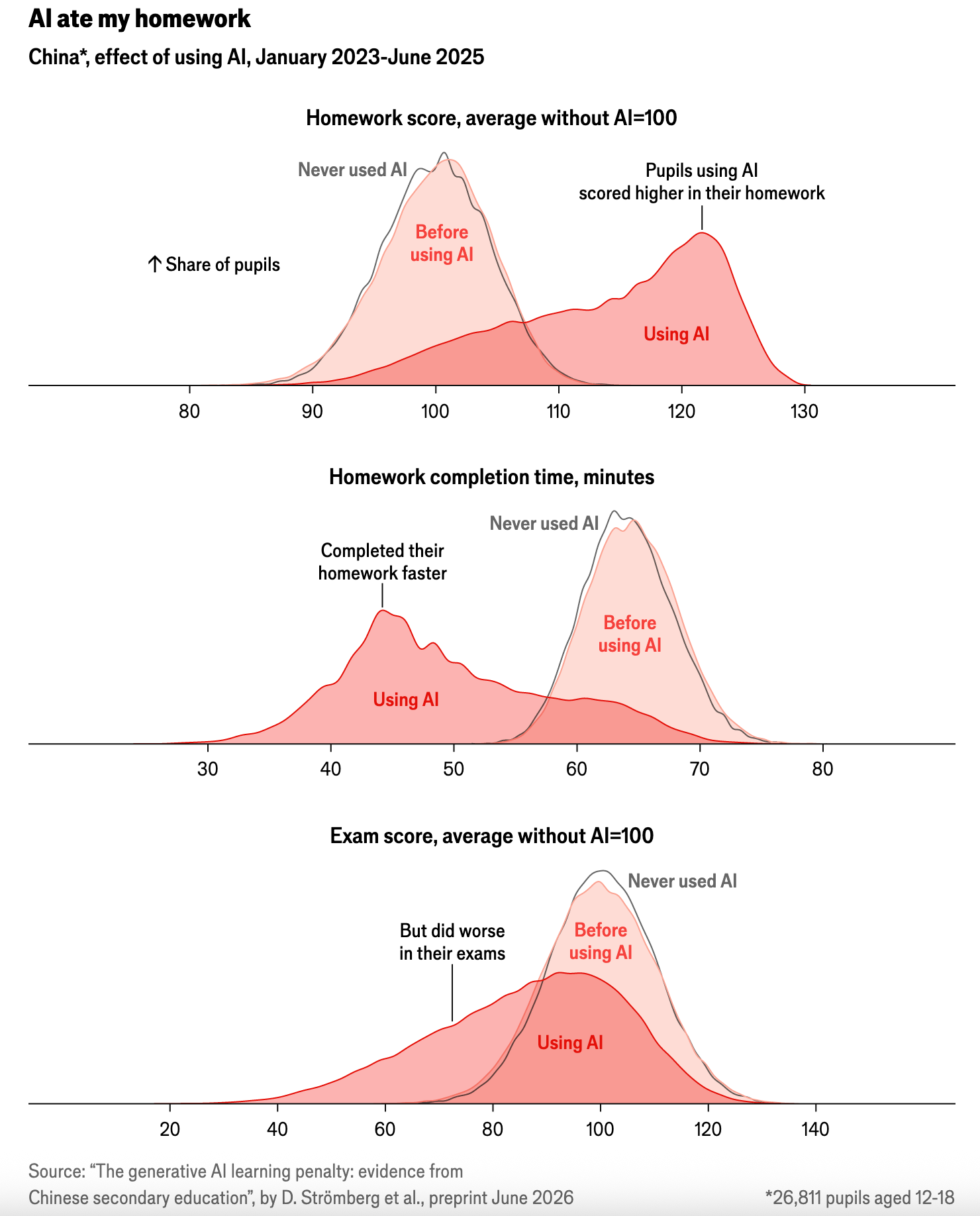
A graph recently published in The Economist, based on a study of AI in Chinese schools, provides one of the most striking outputs of Chabuduo World: in many classrooms, homework scores now anti-correlate with test scores. That is to say: the better students do on homework throughout a semester, the worse they are likely to perform on end-of-semester exams. Students, not a group particularly known for their collective diligence or passion for homework, have replaced themselves with machines that provide perfect outputs on tasks where the only output that actually matters is the internal development they are dodging.
You can blame students for this, and sure, there’s a sense in which we’re all doing it to ourselves. If people would just do the work themselves to learn the material they’re spending tens of thousands of dollars to study, they would get the benefit. But from a system design perspective, we should aspire to something higher. Humans are lazy optimizers who have built countless systems to make it easier and easier to align our short-term interests with our long-term goals. If one student in a class is cheating, it’s a problem with the class. If 56 out of 59 students are cheating, as Inside Higher Ed reported occurring in one Brown University classroom, it’s a problem with the system.


At Education Progress, we run a newsletter with submissions open to the public. Having an open inbox for something like that is always an adventure, with a steady stream of spammers asking how much we charge to run guest posts on crypto or CBD. But recently, we’ve experienced a new phenomenon: credentialed education professionals, under their own names, sending in pitches or full drafts that are obviously, painfully, AI-generated. I have nothing in principle against AI writing: I have been tinkering with it since before even the first version of ChatGPT was released, I have released full conversations with AI on this newsletter before, I have compiled more than 6 million words of my own writing in the hope of sometime training an AI on my style. My problem is not that they are using AI, and not only that they are not disclosing it: it is that the AI writing people submit tends to be low-content mush with predictable and grating tics. It is simply not good writing. But it is good enough that education professionals proactively reach out to publications hoping to attach those piles of mush to their names.
This is a microcosm of what’s been going on everywhere writing exists. As Pew reports, more than one-third of websites published after the release of ChatGPT now show indicators of AI writing. That’s not surprising, not really. There are all sorts of writing genres that exist almost purely because people feel there ought to be more words on the page than “Claude, write me an apology that appeases the mob. Make no mistakes” or “ChatGPT, please write body text for a petition explaining why the news should pull its punches when reporting on academic fraud,” or perhaps “Grok, write me a Wall Street Journal opinion column. Make no mistakes.” It’s not that writing like that would have been polished and full of heart before. But it would have had more personality and variety, it would at least marginally have built the skills of the writers, it would have passed through at least one human mind before hitting the page. We are drowning in chabuduo text written by humans content to let Claude, cordyceps-like, speak through them, text that not even its writers care enough to read.
Right now, we are in a moment of rapid AI progress, in a world that is transforming too quickly to process. But even if these tools implausibly never progress an inch beyond where they are today, they promise to lead us all into Chabuduo World across almost every intellectual discipline. A few determined, serious people – holy people – will spend thousands of hours laboriously pursuing the physical and mental changes that allow them to experience their vocation of choice as an expert rather than as an amateur.
But the rest of us, the rest of the time? A prompt, a box, an output. “Chabuduo.” And a mind that will never, ever develop the patterns it can now outsource to our beautiful new whispering earrings, its owner producing work so good they can almost believe they are thinking. Really, why bother? You were never serious about cultivating that skill anyway, and the AI output is, after all, good enough.
Wow, this is more existentially depressing and terrifying than any x-risk doomer prediction of grey goo and engineered viruses. You got a knack for that, Trace. Don't let it be chabuduo'd away.
I predict that in a generation or two, the few experts standing will be the people absolutely obsessed with the process/love of the game. You know, the weirdoes who put in the thousands of hours of reps because they enjoy it (while most people consider it a slog).
I learned how to write as a kid because I liked writing. I couldn't *not* write. I'm sure lots of artists, as kids, couldn't *not* draw all the time. They'll be the last holdouts of expertise.