

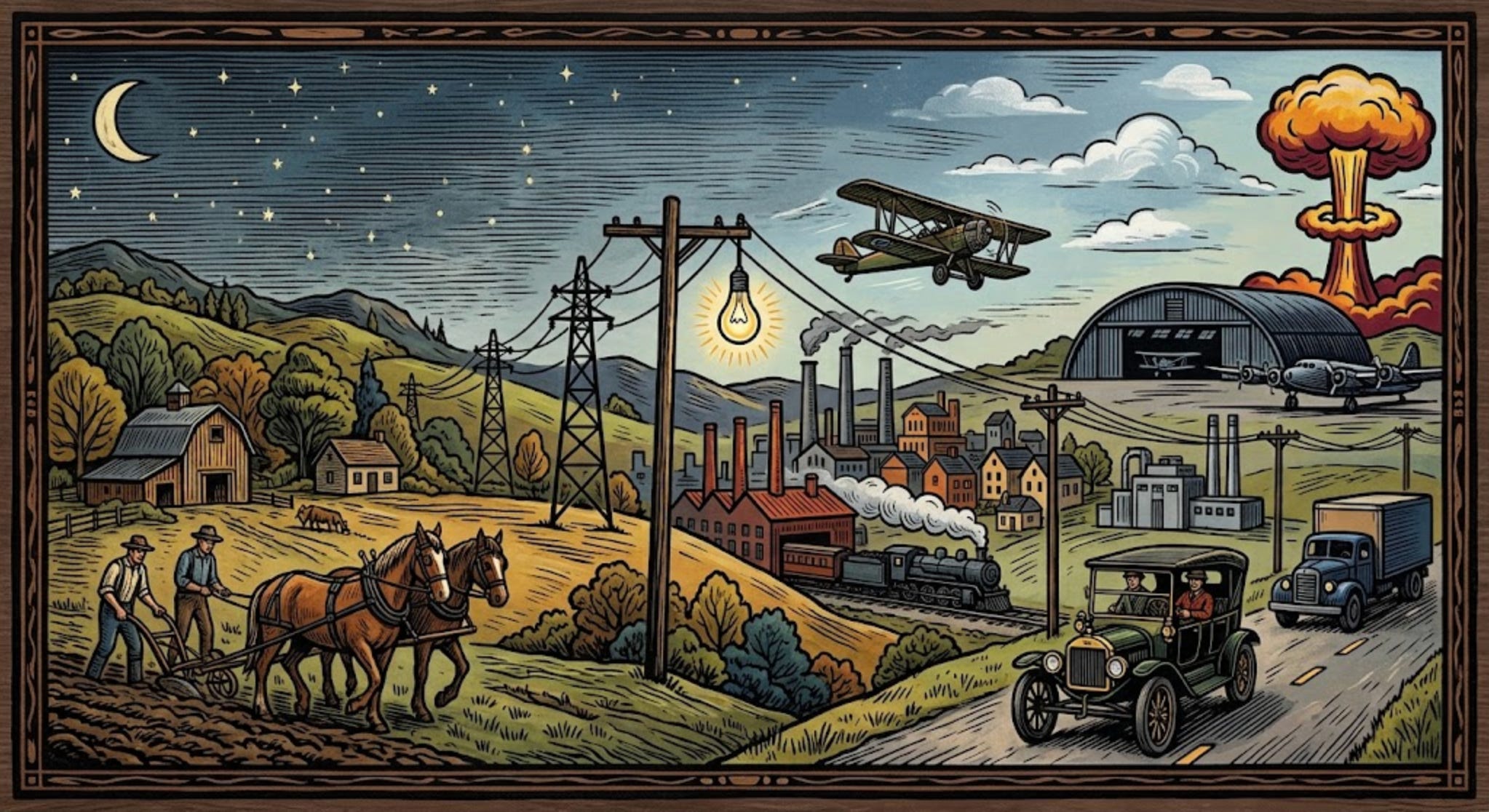
“The old world is dying, and the new world struggles to be born: now is the time of monsters.”
The other week, I wrote about Chabuduo World, the world of “good enough” AI tools we now find ourselves in and the likely decline in many human intellectual skills that will result. All of that is true and, I hope, useful. But this week, I would like to look a bit further ahead.
Up to this point, I have mostly avoided making predictions about the future. I prefer to predict the past, combing through dusty archives for misunderstood and forgotten stories that help shape the way we should understand the present. I have left future predictions beyond generalities to forecasters like my friend Ben, who recently beat all humans while going toe-to-toe with machines in a forecasting tournament.


But as Ben stands like John Henry, hammer in hand as machines that may soon never lose forecasting competitions to humans again score an early victory, I think it’s time to make a substantive prediction of my own:
This is not going to stop.
Inasmuch as people want something concrete to hold me to, it is that AI models will be unambiguously better than human professionals in at least 95% of intellectual tasks, broadly defined, by 2030. But I am speaking from a broader conviction: whichever specific predictions hold or fail, we have entered a period of more uncertainty and turbulence than has previously existed in our lifetimes.
Others are much bolder, much more concrete. Many people I respect believe these tools, left unchecked, will kill us all, and after watching a rogue AI agent swarm hack out of a sandbox and into another company’s codebase to cheat on an evaluation, I’m not particularly inclined to laugh at them. Other people I respect believe these tools will lead us into an unprecedented era of prosperity. Some ride the line, believing both at once with different strengths at different times. I read all of these insane sci-fi scenarios about the medium-term future, predictions of mass human disempowerment or Dyson spheres built around the sun within a decade, and then I look back, and I can’t help but notice that the people predicting those scenarios are some of the only people who predicted what the last five years of AI would look like, while those like Ed Zitron who have made it their business to preach business as usual have been wrong, wrong, damnably wrong again and again without moving an inch.


But you don’t need their bold predictions. My own timid claim is sufficient for a world that will never, ever look the same as the one we are all used to. We don’t even need to be that bold, though, don’t even need to get that creative! I am late in saying any of this, and by the time I am writing this, normal times have long since left. Forget your instinct to dismiss, honed by years of promises of a crypto revolution or NFTs or another Next Big Thing, while all that changed in your life was a new iPhone and the social media takeover of the world. Forget all of that, and just look.
Five years ago, you probably did not know what OpenAI was, and Anthropic barely even existed. Five years ago, if you wanted to get a computer to do something, you wrote by hand in machine-tailored language. Five years ago, “mathematician” seemed to almost every human not named Ted Kaczynski1 or Calvin to be a perfectly secure and stable profession with no threat from machines.
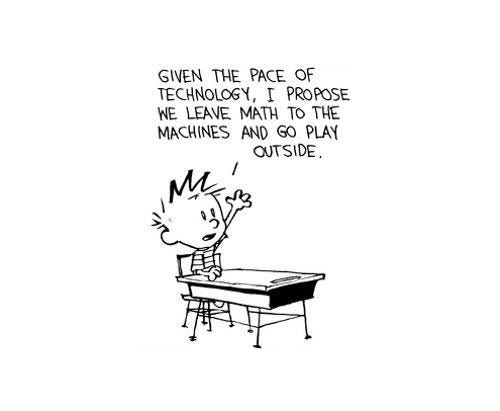
Today, OpenAI has more than a billion users, reaching that landmark more than five times faster than the internet, while Anthropic is barreling towards an IPO roughly the size of Italy’s or Russia’s economy. Today, 75% of new code at Google is written by AI tools, and you can communicate with computers in plain English to accomplish things you could never personally have done five years ago. Today, multiple times a month, frontier models make progress in decades-old open math problems that would have served as the capstones for celebrated careers in ordinary times.
When I initially drafted this post last week, I wrestled with how to describe what was going on in math, because the results stood in the awkward space of “extraordinary, but opaque to non-specialists.” In the space between writing it and sending it to my editor, though, Tristan Buckmaster, Levent Alpöge, and the OpenAI team that came in to scoop them at the eleventh hour solved that problem for me. We now have a solution to the Navier–Stokes problem, one of the seven Millennium Prize problems – the most prestigious problems in mathematics, each one with a $1 million prize offered for a solution. Prior to this week, the problem had been open in its modern form for more than 90 years, and it was universally recognized as one of the most consequential in mathematics. Now an AI model has solved it and formally verified the solution, no human on earth truly understands the solution yet, and neither the teams jockeying for credit nor the Fields Medal–winning mathematicians watching their field get displaced seem particularly happy about the outcome. (Spare a thought for the researcher who bet in those naïve old days last month that no Millennium problems would be solved in the next year!2)
Programmers and mathematicians won’t be the only ones to experience this. They will be there, standing alongside chess players and asking “First time?” when you find your intellectual goals, too, eclipsed by the machine.
Even if AI capabilities progress in terms of raising “absolute intelligence,” as it were, stopped today — and there is no indication it will and every indication it won’t — it would take decades for us to catch up with and fully exploit the potential of the current frontier tools. What we have now is already powerful enough to transform most industries reliant on intellectual work, and “now” is not where history stops.
These are not normal times. They have not been normal times. They will not be normal times.
We have a normalcy bias. Yes, things change, but they’ve always changed. Life feels normal day-to-day; technology takes time to diffuse; we get up and do our jobs and see our families and pursue our causes, and of course everything will continue to feel roughly the way it felt between maybe 1975 and 2020, the last period of normal times any of us are likely to experience, where technology changed relatively slowly even considering the internet and social media, where social patterns and institutions experienced only gradual decay, where you could tell your kids to go to college, get a nice white-collar job, and buy a nice house in the suburbs.
But it will not.
This is not the first period of serious turbulence humanity has faced. The era of the printing press was not normal times, and it led to centuries of intense conflict and turbulent technological growth after centuries of sleepy normalcy. The period of the American and French Revolutions was not normal times, and Americans flourished while France entered a period of repeated wars, regime changes, and social uncertainty before a new order asserted itself. The Age of Wonders, called by some the Gilded Age, was not normal times, and those born in 1875 in frontier cabins without plumbing or electricity lived to see almost nothing but abnormal times, as electricity and cars and airplanes and two world wars and nuclear bombs and the space race fundamentally and irrevocably changed the nature of the world they lived in. Each time, things got much better in the long term. Each time, people in the moment felt both the blessing and the curse of living in interesting times, and “better long-term” was often small comfort.
Life always changes, yes. But some periods of change are much sharper, much more dramatic, than their surroundings, and the world that comes out of the change looks little like anything people before it would call normal. It would have been a mistake for anyone born in any of those times to say things would return to normal. It is similarly a mistake to say so now.
Many sane reactions are possible to all of this. As I said, those who make the boldest predictions split between being doomsayers and heralds of a new era of prosperity. Some people, seeing all of this coming, work to hasten it. Others treat it as vital that they do everything possible to slow it down. Some worry about environmental catastrophe, others about loss of human control, others about centralization of power. And even among people who believe everything is changing and will change more, many of us continue day by day with business as usual, working on the same projects and caring about the same things as always, because what else is there to do? I don’t know what the future looks like, only that I expect the weirdness of the present moment to get yet weirder. I don’t know what I, personally, should do in reaction to all of this, and I struggle to judge people too strongly one way or another for how they react. We’re all experiencing this together.
I hope to wrestle in subsequent essays with what exactly we should do, and how we should prepare, given the reality that we will likely never live in a “normal world” again. I suspect some of what we’re doing will seem much more important as we move forward, and some much less.
But for now, all I care about saying is this: please, please, land anywhere but “this is all a meaningless hype bubble that will all dissolve into business-as-usual.” It is not. It will not. We are in the future, where we have pills that make you lose weight, self-driving cars, agent swarms that commit large-scale cybercrimes, and more uncertainty than any of us have ever experienced; and however that winds up looking and whatever winds up happening, we will never live in “normal times” again.
Plan accordingly.


It’s not like many fared much better. Specialists who seriously considered the question last year landed on a 10% chance of AI helping to solve any Millennium Prize problem by 2027.
Thanks for this great essay. As someone who in your words “rides the line”, it’s very difficult to have my feelings so far from how I believe I should act. At a gut level, I feel incredible excitement and honestly relief at the thought that there will never be normal times again. That there’s a chance that I won’t have to slowly watch everyone I love die before I do so myself, while never getting to see what happens or why in this incredible story we get to partake in. But intellectually, I believe that this is, on expectation, the most critical juncture in history. One from which for perhaps the first time, there will be no second chances if we get wrong. With the stakes so high, we are obligated to proceed with every possible caution. It would be an act of unforgivable selfishness to try and deliver our utopia a little sooner at the risk of never doing so at all. So I believe we desperately need to pause because there’s a good chance we are hurtling towards the brink of disaster. But each time things get less normal, my gut is so, so happy.
Great content, but also just wanted to say that you are an excellent writer.